
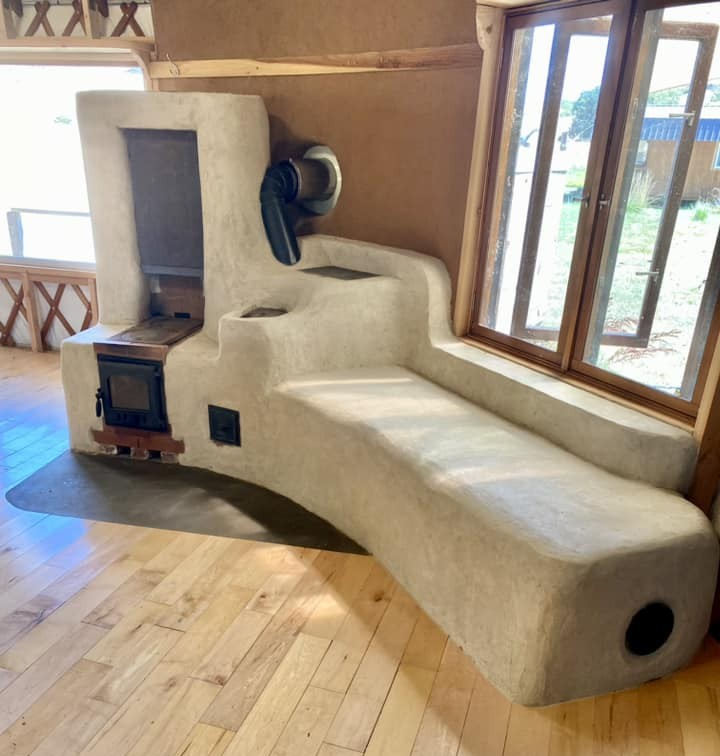
The Rocket Mass Heater is an updated masonry heater with a rocket stove made of inexpensive materials that requires moderate skills to build.
A masonry heater is a wood burning heater, made of brick or stone, that stores heat in the masonry structure, which continues to release heat gradually, even after the fire is no longer burning. They have been used for thousands of years by various cultures around the world. The RMH was invented in the 1980’s.
A rocket stove is an ultra-efficient, wood-burning stove utilizing a thermal siphon.
Traditionally masonry heaters have had high up-front costs: such as the cost of materials, specialized foundations to support their weight, and highly-skilled masons to build.
Our farm house is made of stone. There are stone walls around the perimeter of the building as well as internal stone walls that partition the spaces. Because the building is large, we will build two rocket mass heaters located next to internal walls, thus incorporating the stone walls into the “mass” of the heater.
The rocket stove has numerous benefits: 1) It is easily built from common materials. 2) It offers close to complete combustion of the wood, with just water vapor as residue. 3) It can use wood typically considered too small to call firewood.
The basic rocket stove has three components: Feed tube, Burn tunnel, and Heat riser.

Connected to the rocket stove is a stratification chamber. The hot air from the heat riser enters the upper part of stratification chamber. As the air cools, it sinks to the bottom, where there is an exit to the chimney. The size of the stratification chamber (specifically the internal surface area of the chamber) is important to allow as much heat to absorb into the surrounding masonry as possible, but keep enough heat to expel the water vapor from the chimney. Details on how to calculate the stratification chamber size for a batch rocket stove are here. The rocket stove produces half the heat of the batch stove, so the stratification chamber needs to be half that size.
I’ve made some notes about the dimensions of our heater to determine the quantity of materials I will need. The rocket mass heater consists of a rocket stove about 20″W x 39″D x 59″H with a stratification chamber of about 42″W x 22″D x 59″H. The rocket stove will need to be made of high-temperature brick since the burn tunnel can reach up to 2000o F. The rest will be made of earthen bricks (earth + sand + straw). This summer I will make test bricks to determine the optimal mix of earth + sand + straw, using earth from the property.

Español
El Calentador de Masa Cohete es un calentador de mampostería actualizado con una estufa cohete hecha de materiales económicos que requieren habilidades moderadas para construirse.
Un calentador de mampostería es un calentador de leña, hecho de ladrillo o piedra, que almacena calor en la estructura de mampostería, que continúa liberando calor gradualmente, incluso después de que el fuego deje de arder. Han sido utilizados durante miles de años por diversas culturas de todo el mundo. El Calentador de Masa Cohete fue inventado en los años 80.
Una estufa cohete es una estufa de leña ultraeficiente que utiliza un sifón térmico.
Tradicionalmente, los calefactores de mampostería han tenido altos costes iniciales: como el coste de los materiales, cimientos especializados para soportar su peso y albañiles altamente cualificados para construir.
Nuestra casa de campo está hecha de piedra. Hay muros de piedra alrededor del perímetro del edificio, así como muros interiores de piedra que dividen los espacios. Como el edificio es grande, construiremos dos calentadores de masa cohete situados junto a los muros interiores, incorporando así los muros de piedra a la “masa” del calefactor.
La estufa cohete tiene numerosas ventajas: 1) Se construye fácilmente con materiales comunes. 2) Ofrece una combustión casi completa de la madera, quedando solo vapor de agua como residuo. 3) Puede usar madera que normalmente se considera demasiado pequeña para llamar leña.
La estufa básica de cohetes tiene tres componentes: Tubo de alimentación/Feed tube, Túnel de combustión/Burn tunnel y Subidor de calor/Heat rise.
Conectada a la estufa cohete hay una cámara de estratificación. El aire caliente del elevador de calor entra en la parte superior de la cámara de estratificación. A medida que el aire se enfría, desciende hasta el fondo, donde hay una salida hacia la chimenea. El tamaño de la cámara de estratificación (específicamente la superficie interna de la cámara) es importante para permitir que la mayor cantidad de calor posible se absorba en la mampostería circundante, pero mantener suficiente calor para expulsar el vapor de agua por la chimenea. Aquí hay detalles sobre cómo calcular el tamaño de la cámara de estratificación para una estufa cohete por lotes (batch rocket stove). La estufa cohete produce la mitad del calor que la estufa por lotes (batch rocket stove), por lo que la cámara de estratificación debe tener la mitad de ese tamaño.
He tomado algunas notas sobre las dimensiones de nuestro calentador para determinar la cantidad de materiales que necesitaré. El calentador de masa cohete consiste en una estufa cohete de unos 20″ x 39″ x 59″ con una cámara de estratificación de unos 42″ x 22″ x 59″. La estufa cohete tendrá que estar hecha de ladrillo de alta temperatura, ya que el túnel de combustión puede alcanzar hasta 2000ºF. El resto estará hecho de ladrillos de tierra (tierra + arena + paja). Este verano haré ladrillos de prueba para determinar la mezcla óptima de tierra + arena + paja, usando tierra de la propiedad.